Universes of Images
Screening series and talks
With Kerstin Schroedinger and Angela Melitopoulos
Thursdays 5, 12 & 19 of March, 2026
17:00 - 20:00
In this series of three screenings we will seek to understand image practices that aim to rework archival and found footage that allow for a narration of ‘minor histories’. The ability of image practices to produce facts and the dissolve community have become operative and media agents in the current structures of biopolitical governance. We will watch works that are concerned with the interwoven processes of industrialisation, the formation of modern nationalism, and the violent ruptures modernity implied in the shaping of societies.
The series accompanies the Universes of Images thematic course at the Academy of Fine Arts, led by Mika Elo, Marjaana Keller, and Kerstin Schroedinger. The screening series is programmed and introduced by Kerstin Schroedinger and follows the visiting professorship of artist Angela Melitopoulos at the Academy of Fine Arts.
The screenings are as follows:
Thursday, 5 March, 17:00-20:00
Introduction by Kerstin Schroedinger
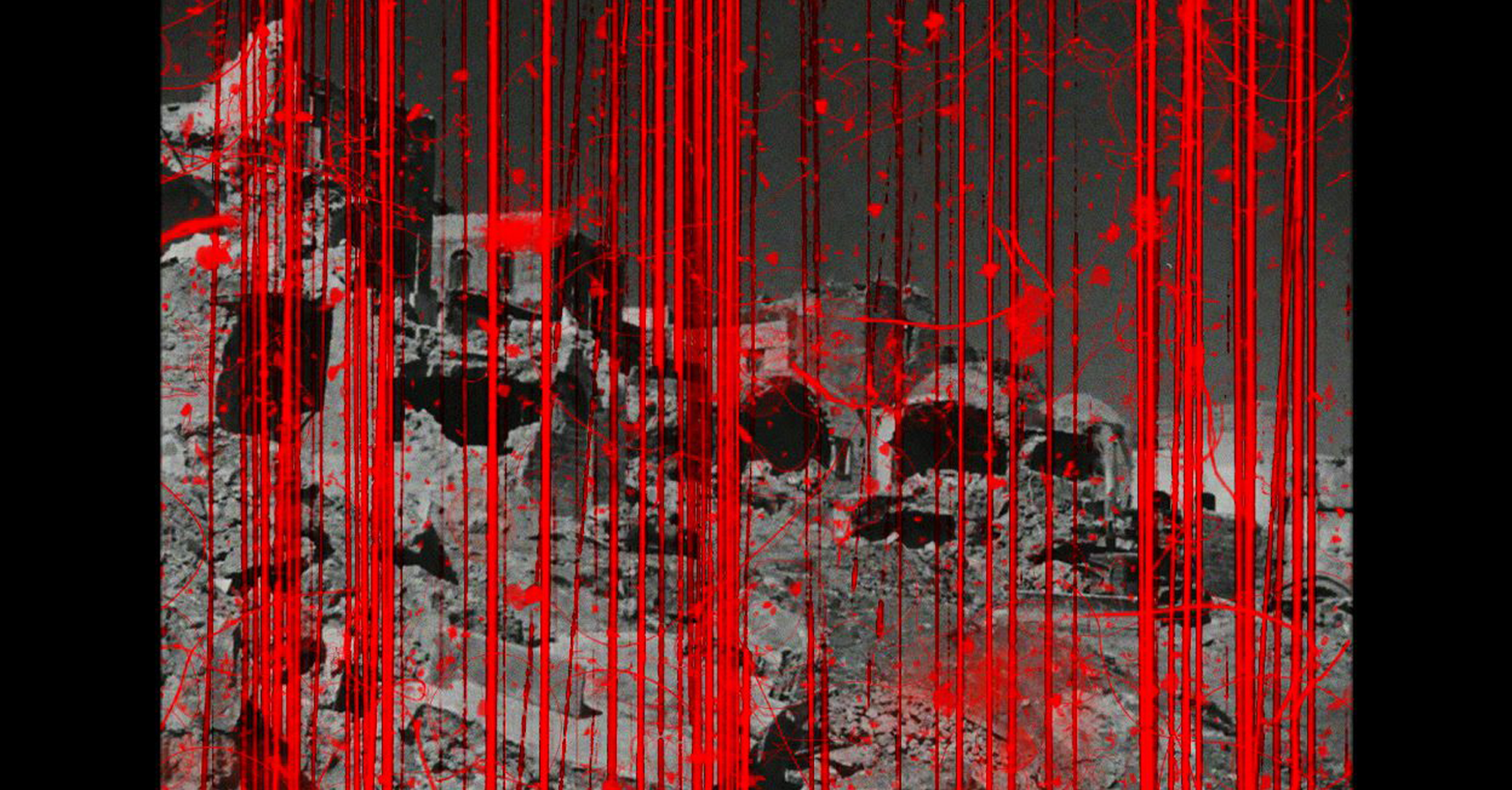
Kamal Aljafari, A Fidai Film, 2024, 76 min
In the summer of 1982, the Israeli army invaded Beirut. During this time, it raided the Palestinian Research Center and looted its entire archive. The archive contained historical documents of Palestine, including a collection of still and moving images. Taking this as a premise, A FIDAI FILM aims to create a counter-narrative to this loss, presenting a form of cinematic sabotage that seeks to reclaim and restore the looted memories of Palestinian history. It’s a poignant exploration of identity, memory, and resistance, told through a unique blend of documentary and experimental filmmaking techniques.
Miranda Penell, Man No. 4, 9 min, UK 2024
Gaza, December 2023. A confrontation with a disturbing photograph on social media triggers questions about what it means to be an onlooker.
Thursday, 12 March, 17:00-20:00
Mareike Bernien/Kerstin Schroedinger, Rainbow’s Gravity, Ger/UK 2014, 33 min
Rainbow's Gravity is a cinematic study on the Agfacolor-Neu colour film stock made in Nazi Germany. Along its three layers of emulsion, the film digs deep into the escapist colourised landscape of this time and asks for the material requirements, retentions and ideological continuities of the Agfacolor palette. The film sequences, projected in the former production line, dismantle not only themselves, but also our view accustomed to historicise. The film tries to realise, not only how it had been - in the darkrooms of the Agfa film factory - but also how it can be possible at all to face this reality today within film, in images and movements without a final or even conciliatory view of the past.
Angela Melitopoulos, The Language of Things, 2007, 37 min
Things, Walter Benjamin tells us, have a mute and inchoate form of speech, yet they communicate with each other by means of a material commonality. This commonality is immediate and magical. Only through the mediation of things can the world be grasped as a whole. The Language of Things is subtitled with quotations from Benjamin’s “On Language as Such, and on the Language of Man” (1916). They appear over the image sequences of a precisely calibrated machinery of acceleration—carousels, wave pools, and the like—from Tokyo’s artificial worlds and high-tech amusement parks. Through the language of technology, the people in the amusement park rides can be outside themselves, ecstatic. For milliseconds, gravity is suspended and speed induces sheer joy. The video screen breaks apart. The technologies of this enjoyment are nonlinguistic effects of a designating and calculated language: the language of humans, with its vocabulary of physical designations, leads to technical knowledge and the calculability of a ect. But to do so, human language also draws upon the language of things: in this sense, the language of things expresses, through technology, that very commonality by which the world seizes upon itself as an undivided whole.
Followed by a conversation with Angela Melitopoulos and Kerstin Schroedinger
Thursday, 19 March, 17:00-20:00
Angela Melitopoulos/Maurizio Lazzarato, Assemblages, 2010, 62 min
Assemblages is an audiovisual research project dedicated to the antiauthoritarian, revolutionary practice of psychiatry, philosophy, aesthetics, and anthropology of Félix Guattari (1930–1992). In an essayistic form, Melitopoulos and Lazzarato took up, triggered, and transposed Guattari’s thought, presenting it in new contexts while concentrating on his interest in animism, conceptions of subjectivity, and ecosophy. They shed light on and developed these issues in relation to Guattari’s practice at the La Borde experimental clinic, his travels, and the presence of his thought in Brazil and Japan.
Guattari’s work proposes the decolonization of thinking, which Melitopoulos and Lazzarato view as a model of work on new expanded subjectivities and their capacities for environment making. Guattari offers a line of flight beyond the Western paradigm of the transcendental human subject, separate from the world of objects as well as other parts of nature and fields of science understood as a tool to conquer the nonhuman world. In his view, subjectivity functions in the form of assemblages—multidimensional montages of heterogeneous phenomena that organize flows between singularities and collectivities, humans and objects, animals, machines, concepts and various cosmic forces.
Through their research into Guattari’s interest in animism, in this three-channel installation, they construct a collective reservoir of Indigenous life practices that are not divided into separate spiritual, material, human, and animal phenomena. In their work, the motif of animism resonates with Guattari’s complex, assemblage-like approach to patients at the La Borde clinic. They also seek out an actualization of animist subjectivities in contemporary micropolitical practices and projects that work toward the decolonization of life in the Brazilian context. Assemblages is composed of fragments of documentaries and interviews with Guattari’s friends and collaborators.
Followed by a conversation with Angela Melitopoulos
Bios:
Angela Melitopoulos is based in Berlin and Mytilene/Greece and has been making video essays, multi screen installations, documentaries and music pieces since 1985. Melitopoulos studied at the Nam June Paik Academy of Art in Düsseldorf, at the Academy of Media Arts in Cologne with Valie Export. She has a Phd in Visual Cultures entitled Machinic Animism and the revolutionary practice of geo-psychiatry. (Goldsmiths University of London, Center for Research Architecture, 2015). Angela Melitopoulos works on cine(so)matic cartographies in which moving bodies and site traversals create mnemonic milieus. Her interest in the theoretical qualities of time-based media include a constant exploration of duration, memory, geography and subjectivity in relation to non-linear narratives and their technical procedures. Her collaboration with sociologist Maurizio Lazzarato in the 1990s led to the book publication Videophilosophy (Edition bbooks Berlin, 1997), which further spun Henri Bergson's theses (Matière et Mémoire) as technical, aesthetic and social memory with media art. Melitopoulos' works are interested in the mnemonic capacities of our perception of time as a digital trace in archives or in the geology of the landscape. The narratives of subterranean, collective memory transmissions stand for a post-colonial alliance. Against a homogenisation of subjectivity, she understands the auto-poetic logic in media art as an order of thought against the mainstream. She tells of deviant, collective forms of memory of resistant subjectivities and of revisions of history, of imperialist violence, fascism and the experience of migrations in the 20th century.
Kerstin Schroedinger works with long-term research-based projects at the intersection of analogue film, video, sound and performance. Her projects are strongly concerned with the social and political formations of time-based media in their historicity and their materiality. She is currently University Researcher at the University of the Arts Helsinki with Chromatic Noise: Mnemopolitics and Autochrome Witnesses, a practice-led research on the historicity and materiality of digital image production from an analogue production environment. She holds a PhD from the University of Westminster, London (2016). Schroedinger’s works have been screened and exhibited at numerous contemporary art museums and events across the world, including at Contemporary Image Collective CIC Cairo, Whitney Museum of American Art New York, 17th Istanbul Biennial, 2nd Kyiv Biennial, and her works have been featured at international film festivals in Berlin, Hong Kong and Toronto, among many others. Since 2019, she has collaborated with Melitopoulos on the music project Zonkey.
